Iván Waisman
Online Therapist in Barcelona, in English
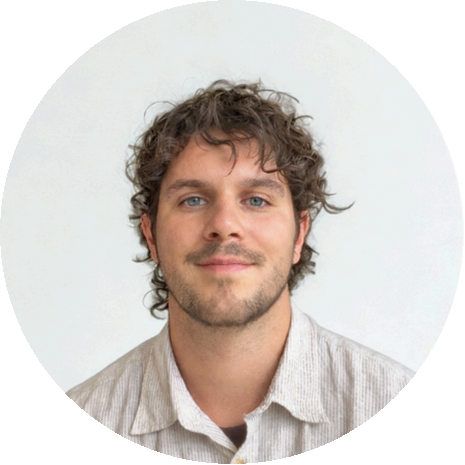
Hi! I'm Iván. I'm a registered psychologist (COP-CAT 36779). I work online with people living in Barcelona, in English or Spanish.
If you're looking for an English-speaking psychologist in Barcelona and wondering how online therapy works, on this page I'll walk you through how our sessions usually go and my fees.
If it speaks to you, feel free to book a first short meeting at no cost. My priority is to help you!
How online sessions work
We meet over Google Meet (unless you'd rather use another platform), and sessions last 50 minutes, sometimes a couple of minutes longer if we need them to. This is how a session with me usually goes:
Every session we build an agenda together. That means I ask first what you need or want from the session; sometimes you'll know, sometimes you won't. Don't worry, I'll always try to have something in mind. We try to keep it flexible because life can change one week to the next one, but keeping in mind to not miss our overall direction.
Once we know where to focus, whether it's something that's currently worrying you, or something you learnt or struggled with during the previous piece of homework, we do a "functional analysis", which simply means trying to understand more precisely what's going on and how to best address it. If we have time (depends on the session), we'll practice some skills or tools personalized to your situation (there are too many to name!) and you'll take a concrete exercise or complementary material into your week to practice or deepen your understanding of what was discussed in the session. Finally, we wrap up with main takeaways so you leave, whenever possible, with a greater sense of clarity.
A few of the skills and exercises we use most:
- Exposure
- Savouring
- Emotion regulation
- Mindfulness
- Values clarification
- Assertive communication
- Self-soothing
I pay special attention to how you're feeling and what you need when you arrive and leave my practice. If you come in particularly tired or shaken and we had a very intense session planned, we might change over to a more self-care oriented one, and if a session gets too intense, we can finish with a relaxation exercise so you leave feeling emotionally regulated.
What you'll need
You'll need a device with a camera and microphone, a pair of earphones and a comfortable spot private enough to be honest and allow yourself to be vulnerable.
A quiet place is what matters most, and above all one private enough to allow ourselves to be vulnerable and honest without fear of what others might think. If you don't have a place of your own, or you're not comfortable at home, whether it's flatmates, family or thin walls, you can join from an office or a park, as long as you have enough privacy.
Is online therapy right for you?
Many people wonder whether therapy through a screen can be the same as sitting in the same room. In my experience, working online very seldom gets in the way: conversation, practice and skills building (even our usual much-needed jokes) flow through naturally, just as they would in the same room. There's also plenty of scientific evidence backing remotely held therapy.
Online also makes the practical side easier: you don't need to cross the city before and after a session, and if you move flats, neighbourhoods or even out of the city, we can carry on together without a break.
For the time being, sessions with people in Barcelona are online only.
If finding a private space is hard, or you know you'd feel better in the same room, tell me on our first call and we'll look at it together. You can count on me to be honest and to guide you in getting the help you need, even if that means someone else.
Online sessions are not the right place for an emergency. If you're in crisis, please call 112 straight away, or 024, Spain's suicide prevention line.
How I work
My main therapeutic approach is Acceptance and Commitment Therapy (ACT), a contemporary form of CBT that grew out of behaviour therapy and scientific psychology. I'm also trained in DBT (Dialectical Behaviour Therapy) and FAP (Functional Analytic Psychotherapy), which, together with ACT, belong to what are often called the third-wave, or contextual, therapies.
In practice, we don't argue with every thought or try to make difficult feelings disappear, which usually makes things worse. Our minds are brilliant problem-solvers, but they also produce harsh judgements, endless worries and old stories that can end up running our lives. In therapy, we learn to relate to our inner and external world in a kinder and more effective way: we learn how to listen to our difficult emotions and thoughts, which often point to what we care about most, but without letting them steer our lives altogether. I see you as a complete human, and that involves your current situation, your goals and expectations for the future, and also your history. Regarding the latter, it's worth mentioning we do delve into your history, for some parts of it might really matter to you, might help clarify your values or give context to why you're feeling the way you are. Still, our main focus is how you want to live and how to get there, starting now.
I try to keep our sessions flexible enough to deal with things as they come, and structured enough to keep a steady direction.
If you'd like to read more about specific areas, I also have pages on self-esteem and perfectionism, anxiety therapy and therapy for expats in Barcelona.
- ACT
- DBT
- FAP
Fees and how often we meet
I want to make sure that income or time are not an obstacle for you to continue your process. That's why I try to adapt both my fees and schedule to match your needs (more on that on my intake form). As for frequency, most studies on psychotherapy are on a weekly basis, so that's the suggested starting point; but it's not an obligation: you can come at your own rhythm.
You book your sessions on your own in my calendar, and we agree together on the frequency as needed.
I gladly offer a first short meeting at no cost to see if we get along and to answer any questions you might have regarding my approach or your specific situation.
Questions people ask
What happens if the connection fails?
It very rarely happens, and when it does, adjusting the connection or moving to a different room is usually more than enough. If it still fails, we can switch to an audio-only call as an exception, or postpone the session until the connection is working again.
Can I get diagnosed online?
We start by understanding what's happening for you, in which situations and what keeps it going, rather than by looking for a label. I pay special attention to transdiagnostic processes, which means processes such as rumination, worry or cognitive fusion (getting tangled up in our thoughts) that show up across many different diagnoses and are studied by cutting-edge research in Psychology. That assessment doesn't stop after the first session: it carries on in every session, together with deciding where to focus and checking how it's going. If you need a formal diagnosis or a written report, feel free to ask me about it on our first call, and I'll tell you what I can and can't offer in your specific situation.
Can we meet in person in Barcelona?
For the time being, sessions with people in Barcelona are online only. If you'd rather meet in the same room, please tell me on our first call or in my intake form (I ask about it at the end), and we'll look together at what works best for you.
Living somewhere else in Spain? Here's how therapy in English across Spain works with me.